

Whilst it may appear quite obvious, the word “law” has 41 different meanings. However, the general description and usage of it can be stated as “a rule, usually made by a government, that is used to order the way in which a society behaves” (Cambridge Dictionary, “Law”).
In another way, the overarching purposes of law are to maintain social order, ensure equality among all citizens, providing a fair justice system, resolving disputes peacefully and protecting the rights and liberties of an individual. It acts as an framework and guideline for our society to follow in cases of uncertainty and injustices.
Even though countries can have different legal systems – civil law, common law, religious law, customary law and hybrid or mixed systems – all are characterized by these purposes, even with different approaches.
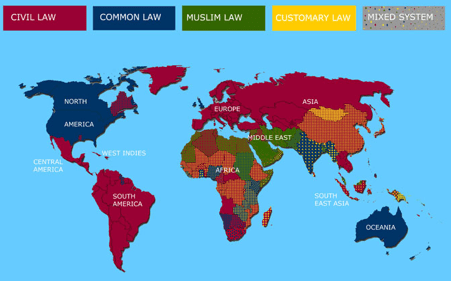
(“02.01 Legal Systems of the World”)
As seen in the diagram above, civil and common law are the most frequent legal systems used. But why? And what is the difference? Well first of all, they are the most common legal systems in the world because of historical and colonial factors, as well as the different ways they manage codification and judicial precedent. The major difference between common law and civil law systems is how laws are established and applied.
Common law, which is employed in nations such as the United States and the United Kingdom, is based on earlier court decisions (known as precedents), therefore judges have an important role in shaping the law. In contrast, civil law, which is widespread in Europe and Latin America, is based on go into detail legal codes written by legislators, which judges merely apply.
In common law, judges can influence future cases through their decisions, whereas in civil law, judges obey to the prescribed code and do not create new laws. The common law system is more adaptable, evolving over time through court rulings, whereas civil law emphasises stability and defined norms that are changed by legislators.
The courtroom approach also differs; Common law takes an adversarial approach, with lawyers debating and presenting evidence, whereas civil law is inquisitorial, with judges leading enquiries. Common law is practiced throughout former British colonies, whereas civil law is predominant in Europe, Latin America, and parts of Asia.
Nevertheless, all legal systems follow a set of laws which focusses on a specific business, industry, or activity:
- Common/civil/criminal law
- Tax/labour/employment law
- Coporate/Copyright/employment law
- Contract/company/intellectual property law
In summary, this human-made concept serves as a vital and reliable guideline for ensuring public safety, upholding justice, and maintaining social order. The challenges it encounters contribute to its evolution, highlighting the important role of lawyers in safeguarding and strengthening our society for good.
Trust me, things are about to get even more interesting






 The next executive minds
Leave a comment